Documentation · Confluence Cloud · Toine.com B.V.
Test Plan and Test Report for Confluence
Two macros: a test plan with objective, scope, approach, entry and exit criteria, environments, roles, schedule and risks; a test report with results, deviations, verdict and recommendation. Jira counts from a JQL scope. Approvers sign per version.
Marketplace listing · 30 day free trial, paid via Atlassian · Support: contact@toine.com · Updated 2026-10-11
What it does
Test Plan and Test Report for Confluence puts the two documents every test effort needs on the page where the team already writes: a plan before, a report after.
The Test plan macro has the sections of a test plan as ISO/IEC/IEEE 29119-3 describes it, cut down to what people fill in: objective, in scope, out of scope, approach, entry criteria, exit criteria, environments and data, roles, schedule, risks and assumptions, deliverables. Each section has a hint that says what belongs there. Text saves as you type.
The Test report macro has the sections of a test completion report: summary, what was executed, results, defects, deviations from the plan, outstanding risks, recommendation, plus a verdict (fit for release, fit with conditions, not fit) with its conditions.
Works with Confluence Cloud, and with Jira Cloud for the counts.
Demo video
About a minute: the core features and the user flow, recorded in the app's demo mode with sample data from a fictional payments team. Every step carries a caption. Test Plan and Test Report: two Confluence macros with live counts from Jira.
Key features
The plan, in the shape reviewers expect
Eleven sections in the order of a 29119 test plan, each with a hint that says what belongs there. Saves as you type. A version number, a status from draft to approved, and a history of every change.
Numbers from Jira, next to the words
Give the plan or the report a JQL scope and count it: work items and how many are done, tests passed, failed and not run, defects open and high. Refresh whenever you like; the report keeps the counts it was approved with.
Sign-off that means something
List the approvers. Each one approves the version in front of them, with a note. When the last approval is in, the document is approved and read-only. A new version resets the approvals and keeps the old ones in the history.
Both take a JQL scope. Count it and the macro shows work items and how many are done, tests passed, failed and not run, and defects open and high, read live from Jira Cloud on the same site once the app is connected to Jira, or entered by hand. The counts stay with the document, so an approved report keeps the numbers it was approved with.
Both have a version number, a status (draft, in review, approved, superseded), a sign-off block and a history. List the approvers; each approves the version in front of them. When every approval is in, the document is approved and read-only. A new version resets the approvals and drops the status back to draft; the old approvals stay in the history. Copy any document as Markdown.
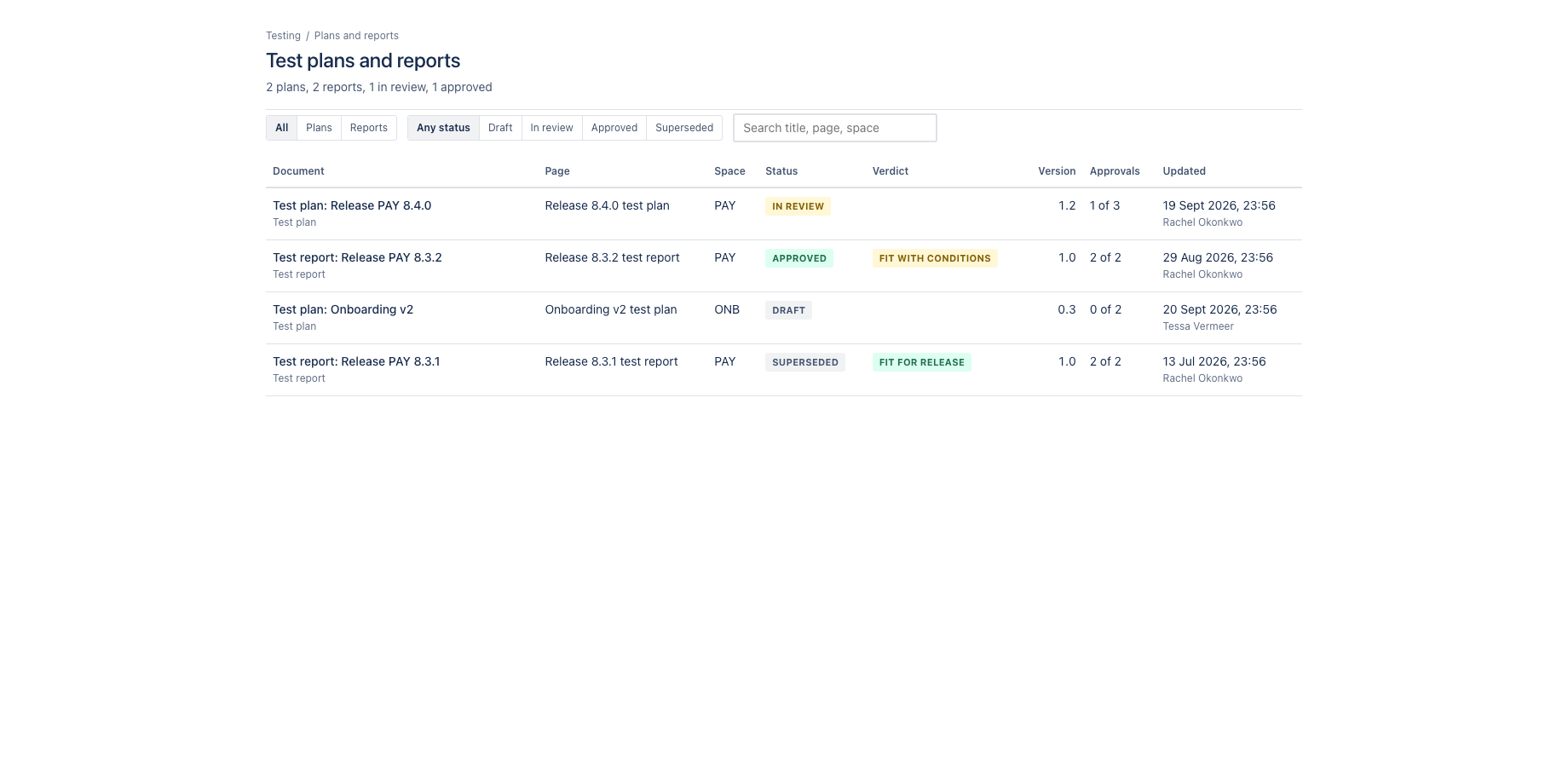
A global page under Apps lists every plan and report on the site with its page, space, status, version and approvals.
What it does not do: it never edits a Confluence page body or a Jira issue. It calls no external service and keeps documents in Forge storage on your site, which is why it qualifies for the Runs on Atlassian programme. Live Jira counts need the app connected to Jira on the same site: a site admin does this once in Atlassian Administration, under Connected apps, the Connections tab. Without the connection everything else works and the counts can be entered by hand.
Where it appears in Confluence
- Page macro
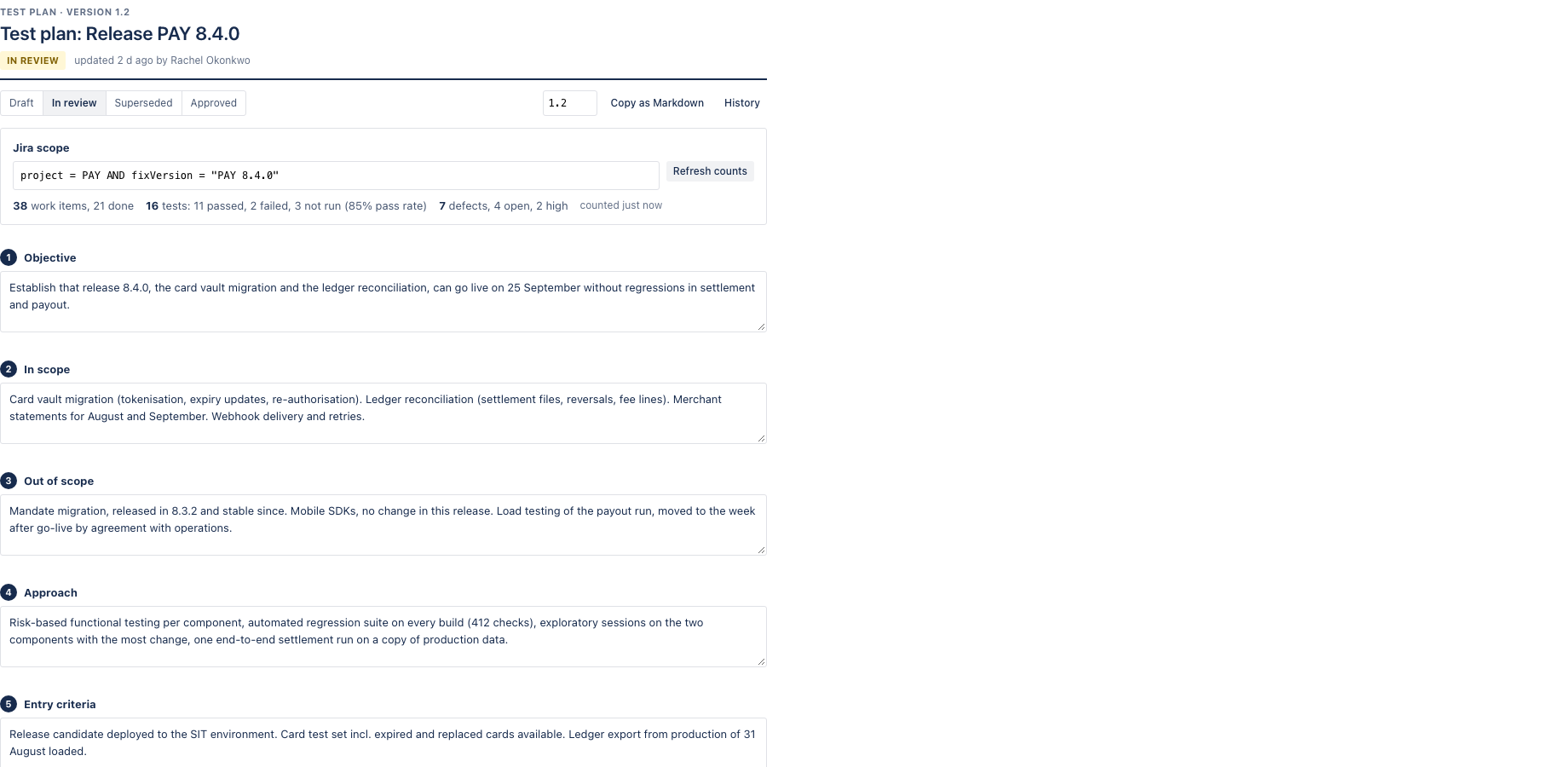
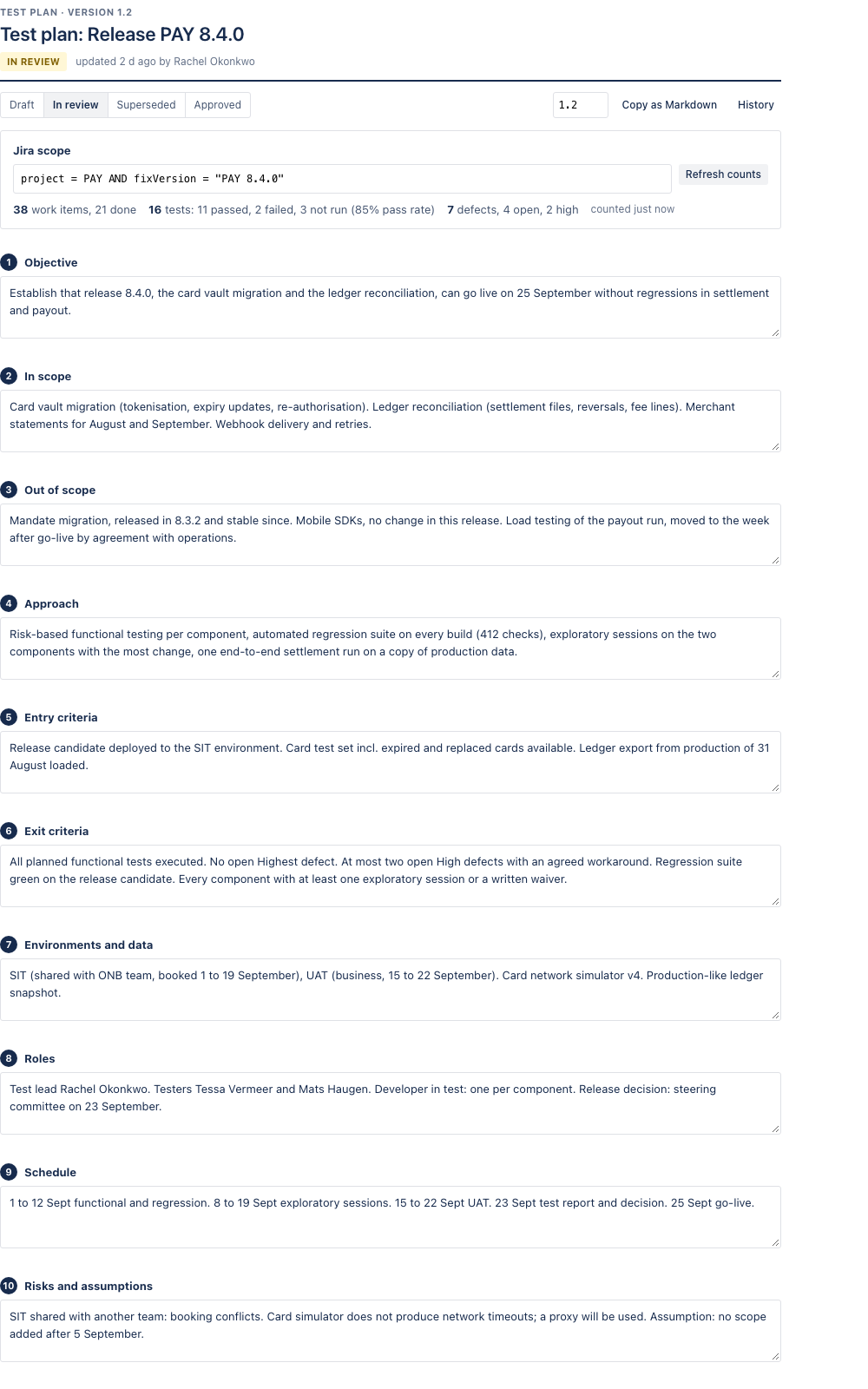
- Test plan macro: a test plan on a page, with eleven sections, version, status and sign-off.
- Page macro
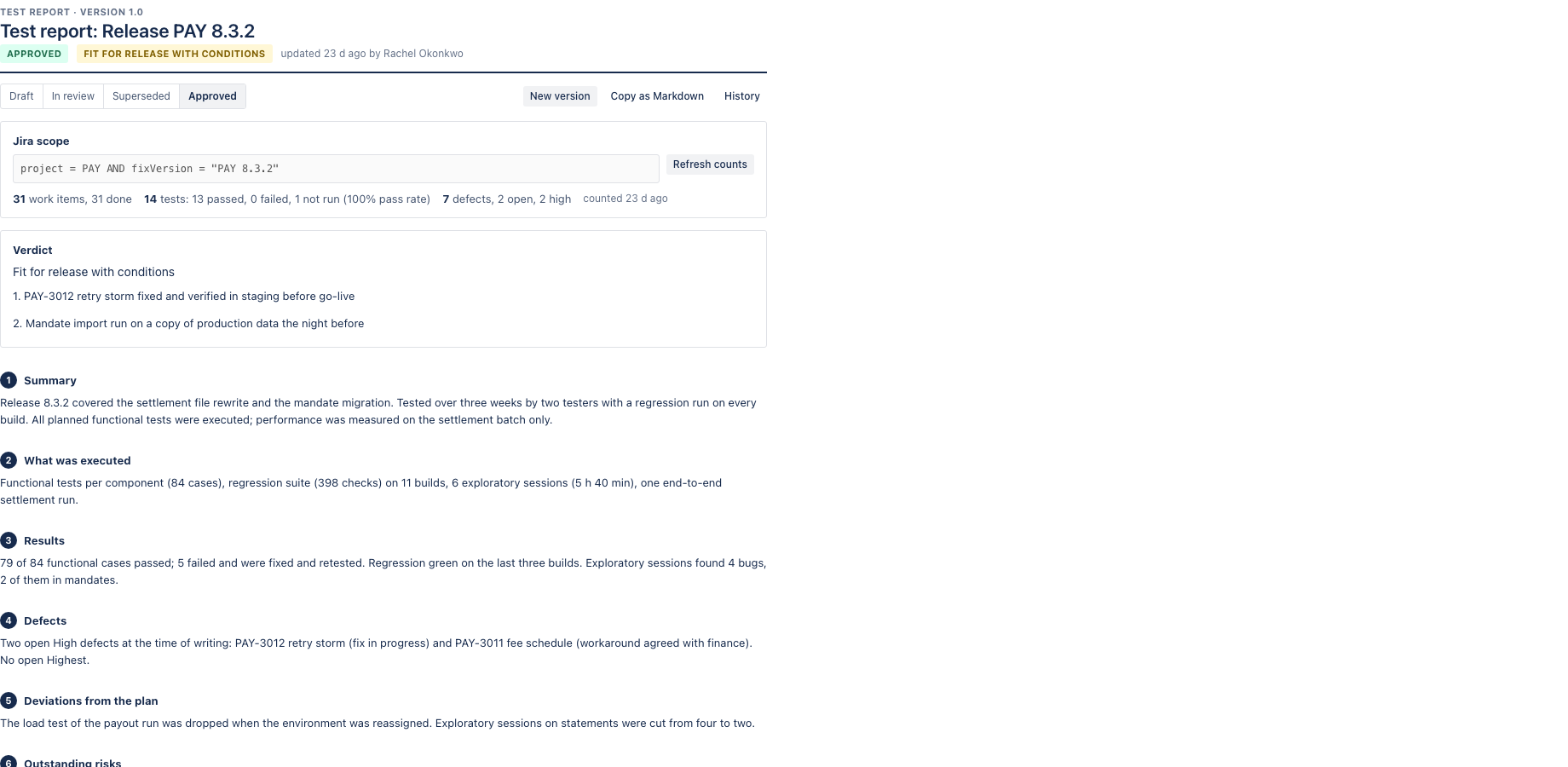
- Test report macro: a test completion report with results, verdict and sign-off.
- Global page
- Apps, Test plans and reports: every plan and report on the site with page, space, status, version and approvals.
Install and set up
Before you start
A Confluence page you can edit. For live counts, a Jira Cloud product on the same Atlassian site that the app is connected to (a site admin connects it once, see step 4 below) and a JQL scope. Without that connection everything works and the counts can be entered by hand.
Install
- In Confluence, open Apps in the top bar and choose Find new apps. Search for Test Plan and Test Report for Confluence and click Try it free. You need to be a Confluence site administrator.
- Review the permissions. The app asks for
read:confluence-user,read:page:confluence,read:content-details:confluence,read:jira-work,storage:app. It never edits a page body. - The 30 day trial starts on install. Billing after the trial is per user through Atlassian; nothing is charged if you uninstall before the trial ends.
Set up
- Edit a Confluence page, type /Test plan and insert the macro. Publish the page. The macro renders the plan with its eleven sections and hints.
- Fill in the sections. Text saves as you type and is stored per version.
- Enter a JQL scope and click Count. The macro shows work items and how many are done, tests passed, failed and not run, and defects open and high. If the app is not connected to Jira, the macro says so and opens a form where you type the counts by hand; they are stored with the document and marked entered by hand.
- Optional, live counts: a site admin opens Atlassian Administration, Connected apps, selects this app, opens the Connections tab and clicks Connect next to Jira. Then click Refresh counts in the macro.
- Under Sign-off list the approvers. Each approves the version in front of them. For the report, insert the Test report macro the same way, on the same or another page.
Using the app
The steps below follow the demo video, in the same order.
- The test plan macro: version, status, and the Jira scope counted live
- Eleven sections, from objective to deliverables, saved as you type
- Type in any section; the text is stored per version
- Scroll through approach, entry and exit criteria, environments, roles and schedule
- Sign-off: approvers per version, each with a note; Approve records who signed and when
- History shows every version; Copy as Markdown exports the plan
- The test report macro: seven sections plus a verdict with conditions
- New version supersedes the current one; approvers sign per version
- The global page lists every plan and report on the site, with status and search
Verify it works
A short test script. Each step names what to do and what you should see. Together they cover every module of the app.
| # | Do this | Expected result |
|---|---|---|
| 1 | Insert the Test plan macro, type in the Objective section and reload the page. | The text is still there and the page body itself was not changed (check the page history: no new page version). |
| 2 | Enter a JQL scope and click Count. | With Jira connected, the counts match the same JQL in Jira and are stored with the document. Without the connection you get a plain message and a form for counts typed by hand. |
| 3 | Without the Jira connection, type counts in the form and save, then reload the page. | The numbers are still there, marked entered by hand. |
| 4 | Add two approvers and approve as both. | The status moves to approved and the sections become read-only. |
| 5 | Click New version. | Version 2 is a draft with the approvals reset; version 1 and its approvals stay in the history. |
| 6 | Insert the Test report macro and set a verdict with conditions. | The verdict and conditions are shown in the report header. |
| 7 | Open Apps, Test plans and reports. | Both documents are listed with page, space, status and version; search finds them by title. |
Screenshots
Permissions and data
Scopes and why
- read:confluence-user: find approvers by name and show display names.
- read:confluence-content.summary: show the page title in the global list.
- read:jira-work: count the issues in a JQL scope.
- storage:app: keep documents on the customer's site.
What the app stores
Plans and reports (sections, JQL scope and stored counts, version, status, approvers with account ID, display name and time, history). No page content.
Everything is stored in Forge app storage on your own Atlassian site and removed under the Forge storage lifecycle when you uninstall. The app calls no external service, sends nothing out of Atlassian and uses no analytics. Data residency follows your site.
More in the privacy policy and the security policy for the apps.
Pricing, trial and support
Paid via Atlassian, per user, monthly or yearly, with a 30 day free trial. The current price for your user tier is on the Marketplace listing. Billing, invoices and cancellation run through your Atlassian site administration.
Questions, bugs and feature requests go to contact@toine.com. I answer within two working days, Monday to Friday, CET. Please add your site URL, the app name and a screenshot. Security issues go first: put "security" in the subject line. Terms are on the terms and licence page.