Documentation · Confluence Cloud · Toine.com B.V.
Lessons Learned for Confluence
A Lessons learned macro for retrospective pages: each lesson in three parts, what happened, why it mattered, what to do next time. Keep, change or avoid. Votes, tags, an owner, and an applied-in list of where each was used. A site-wide register.
Marketplace listing · 30 day free trial, paid via Atlassian · Support: contact@toine.com · Updated 2026-10-07
What it does
Lessons Learned for Confluence turns the last item of every retrospective into something that gets found again.
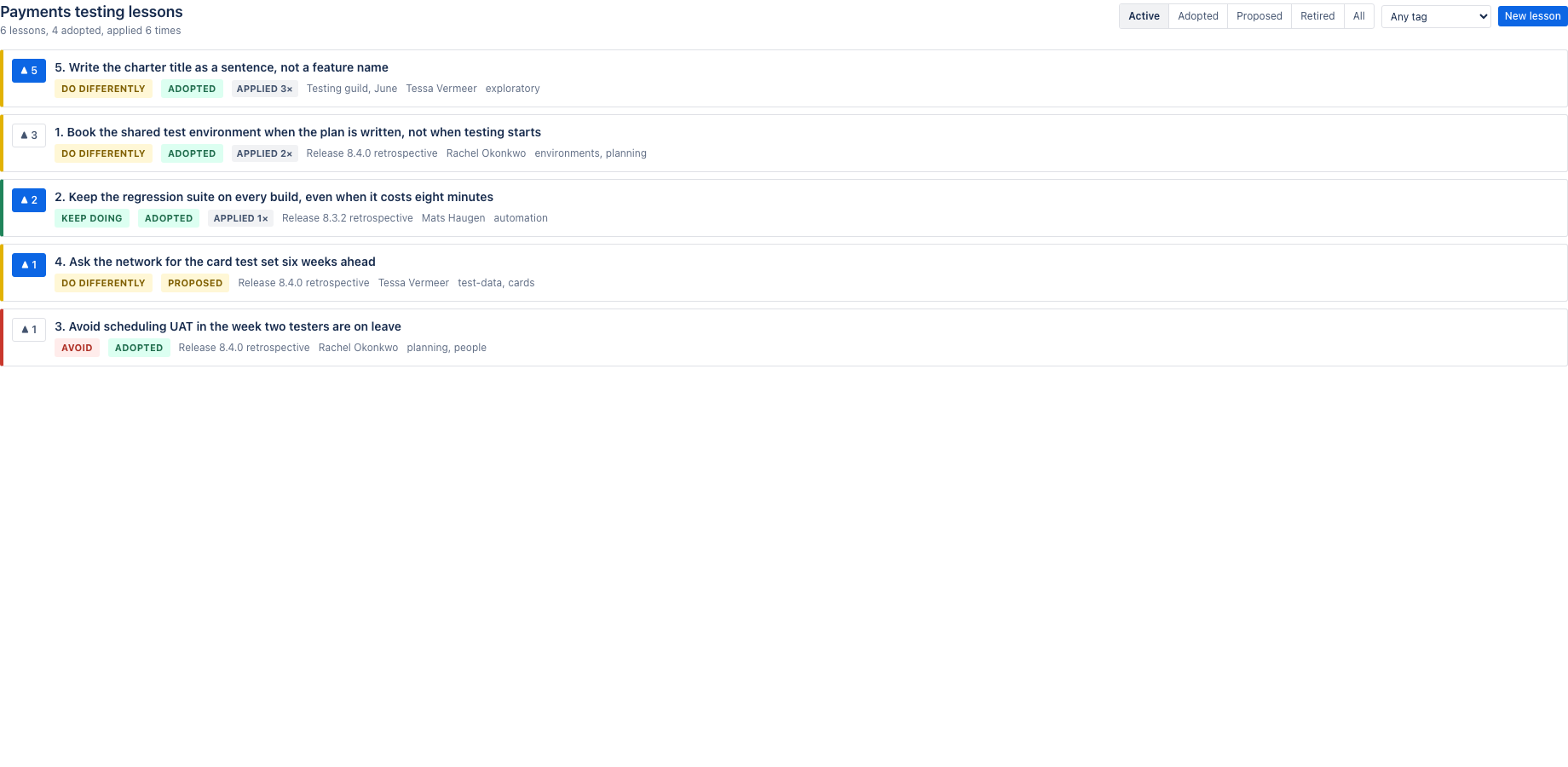
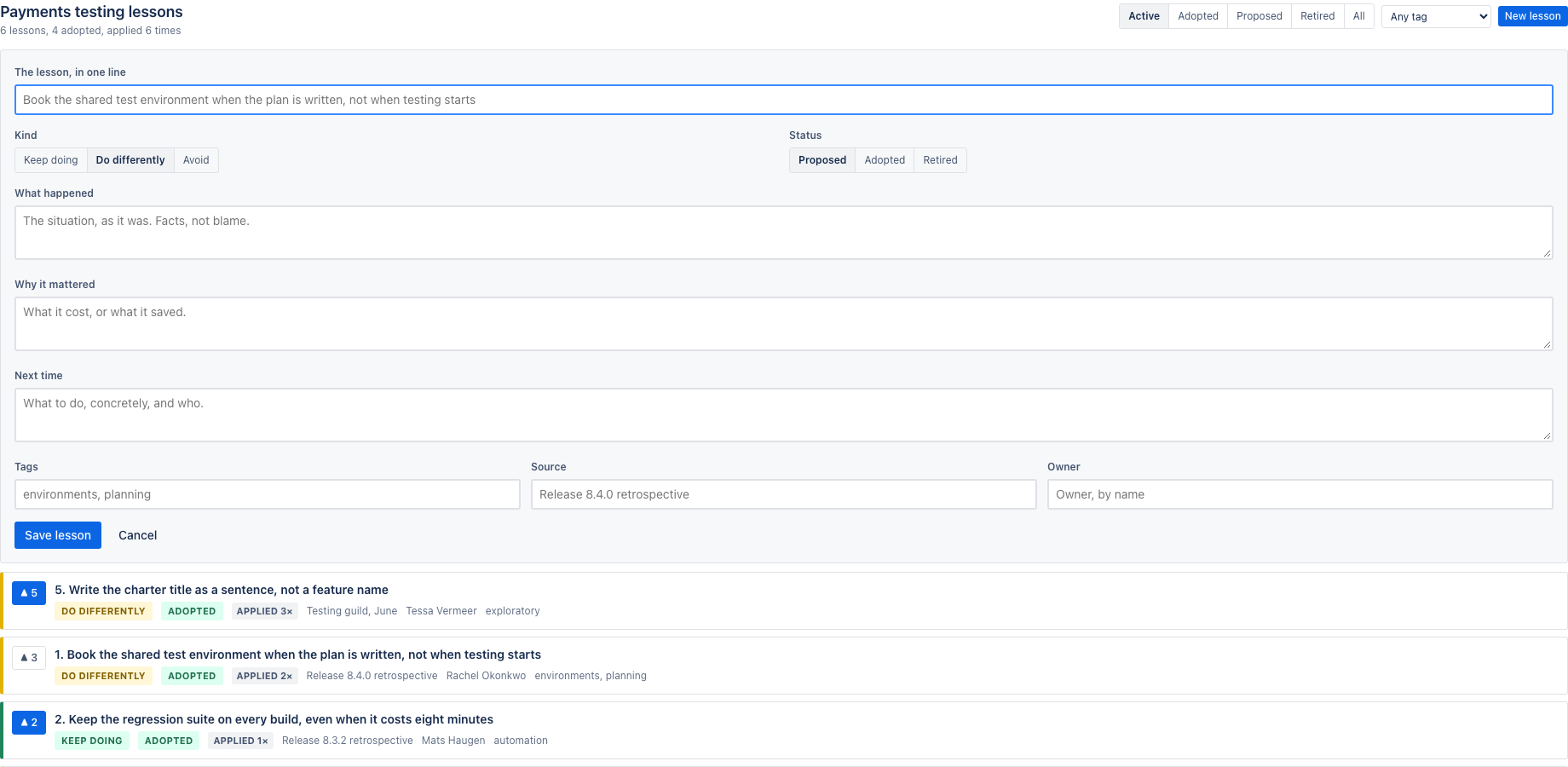
Insert the Lessons learned macro on a retrospective page. A lesson is a one-line statement and three short sections: what happened, why it mattered, what to do next time. It is marked keep doing, do differently or avoid, tagged, given a source and an owner. Colleagues mark a lesson useful; anyone who applies it adds where, with a link. Lessons are proposed, adopted or retired; the log keeps the history.
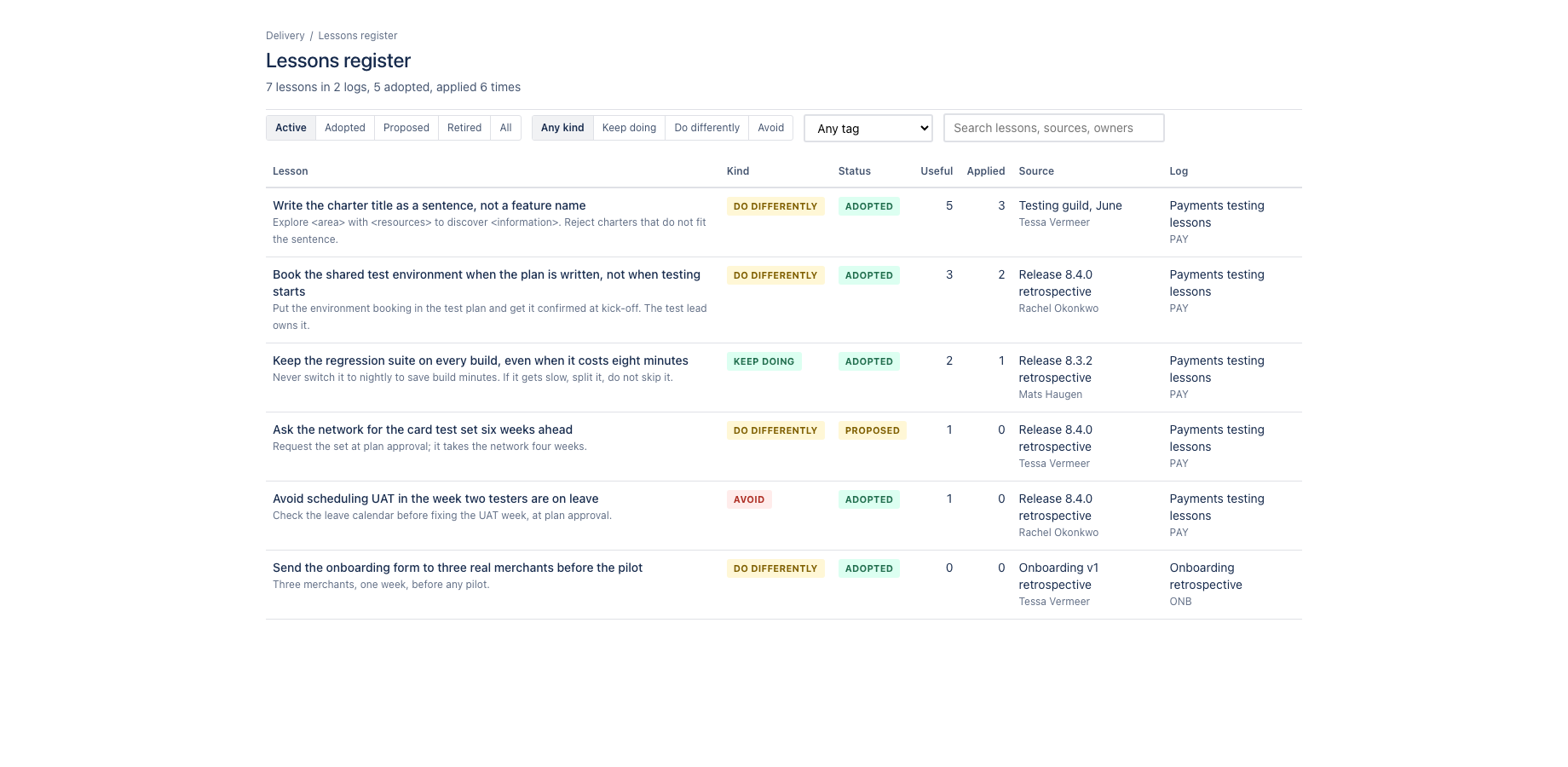
The list sorts by usefulness and use, filters by status and tag, and copies any lesson as Markdown. The Lessons register under Apps shows every lesson on the site the same way, so the next project starts from what the last one learned.
Works with Confluence Cloud.
Demo video
About a minute: the core features and the user flow, recorded in the app's demo mode with sample data from a fictional payments team. Every step carries a caption. Lessons Learned: lessons from retrospectives, voted and tracked where they were applied.
Key features
Three sentences and a tag
What happened, why it mattered, what to do next time. Marked keep doing, do differently or avoid. Proposed by whoever saw it, adopted by the team, retired when it no longer applies.
Applied in
When a lesson gets used, say where, with a link. The count travels with the lesson, so the register shows which lessons have a track record and which never left the page.
Lessons that travel between projects
Every lessons log on every page feeds one register under Apps, most used first: filter by status, kind and tag, search across lessons, sources and owners, open the page with one click.
What it does not do: it never edits the page body, it calls no external service, and it keeps lessons in Forge storage on your site, which is why it qualifies for the Runs on Atlassian programme.
Where it appears in Confluence
- Page macro
- Lessons learned macro: the log on the page where the team works.
- Global page
- Apps, Lessons register: every lesson on the site, with filters and search.
Install and set up
Before you start
A Confluence page you can edit. One page can hold one log; a site can hold any number of logs.
Install
- In Confluence, open Apps in the top bar and choose Find new apps. Search for Lessons Learned for Confluence and click Try it free. You need to be a Confluence site administrator.
- Review the permissions. The app asks for
read:confluence-user,read:page:confluence,read:content-details:confluence,storage:app. It never edits a page body. - The 30 day trial starts on install. Billing after the trial is per user through Atlassian; nothing is charged if you uninstall before the trial ends.
Set up
- Edit a Confluence page, type /Lessons learned and insert the macro. Give the log a name and publish the page.
- Click New lesson in the macro and fill in the form. Save; the lesson appears in the log.
- Use the filters above the table to narrow the log, or Copy as Markdown to take a lesson elsewhere.
- Open Apps, Lessons register for every lesson on the site.
Using the app
The steps below follow the demo video, in the same order.
- Vote a lesson up; filter by status, kind or tag
- Open a lesson: what happened, why it mattered, what to do next time, and where it was applied
- Record where a lesson was applied
- New lesson: title, kind (keep doing, do differently, avoid), status, source and owner
- Save: the lesson appears in the log, ready for votes
- The Lessons register: every lesson on the site with source, owner and votes
- Filter by status and kind, or search lessons, sources and owners
Verify it works
A short test script. Each step names what to do and what you should see. Together they cover every module of the app.
| # | Do this | Expected result |
|---|---|---|
| 1 | Insert the Lessons learned macro on a retrospective page and add a lesson with what happened, why it mattered and what to do next time. | The lesson appears in the log, marked keep doing, do differently or avoid. |
| 2 | Click the vote button as two different users. | The count shows 2 and the lesson sorts above lessons with fewer votes. |
| 3 | Under Applied in, add where the lesson was applied with a link. | The entry is listed under the lesson with who added it. |
| 4 | Change the status from proposed to adopted. | The history records the change. |
| 5 | Open Apps, Lessons register. | Every lesson on the site, most used first; filter by status and kind, search by title, source or owner. |
Screenshots
Permissions and data
Scopes and why
- read:confluence-user: find owners by name and show display names.
- read:page:confluence and read:content-details:confluence: show page titles in the register and search users.
- storage:app: keep logs on the customer's site.
What the app stores
Lessons (title, kind, status, source, owner account ID and display name, three sections, tags, votes by account ID, applied-in entries, history) per log, with the page ID the log lives on.
Everything is stored in Forge app storage on your own Atlassian site and removed under the Forge storage lifecycle when you uninstall. The app calls no external service, sends nothing out of Atlassian and uses no analytics. Data residency follows your site.
More in the privacy policy and the security policy for the apps.
Pricing, trial and support
Paid via Atlassian, per user, monthly or yearly, with a 30 day free trial. The current price for your user tier is on the Marketplace listing. Billing, invoices and cancellation run through your Atlassian site administration.
Questions, bugs and feature requests go to contact@toine.com. I answer within two working days, Monday to Friday, CET. Please add your site URL, the app name and a screenshot. Security issues go first: put "security" in the subject line. Terms are on the terms and licence page.